Learning T'ai Chi Chuan, I learned a valuable lesson about the often misunderstood Yin and Yang.
I understood them on an intellectual level, from my study of Taoism and Traditional Chinese Medicine. I knew not to think of Western dualism, the product of Zoroastrian influence. I've talked before of the descriptions in The Web That Has No Weaver by Ted J. Kaptchuk. His five descriptions greatly helped me understand Yin and Yang:
- All things have two facets: a Yin aspect and a Yang aspect.
- Any Yin or Yang aspect can be further divided into Yin and Yang.
- Yin and Yang mutually create each other.
- Yin and Yang control each other.
- Yin and Yang transform into each other.

These principles describe a concept foreign to most Westerners. The poetic understanding of the two is a hill on a sunny day, with no other hills or trees or mountains to cast shadows. Before Dawn, the hill is all in darkness, is all shadow, is all Yin. As the sun rises in the morning, it hits the Eastern side of the hill. This is Yang. The Western side is still in shadow, still Yin. As the sun rises, the Yang part grows and the Yin shrinks. Yin transforms into Yang. by noon, the entire hill is sunny, all Yang, no shadow, no Yin. But this doesn't last long. As the sun moves West, the Eastern edge darkens, shadow forms at the base, Yin, then grows as the sunny section shrinks. Yang transforms into Yin. As Dusk fades, it is all Yin again. Yet it's all one hill. The hill doesn't change, only the ever changing light. It is Yin changing to Yang, changing to Yin again. But it's all one, the Tao.
Easy to understand intellectually and to observe, but what does it mean personally, how does it effect me and you specifically, beyond the intellect? This is what T'ai Chi Chuang taught me.
T'ai Chi is the tent with a ridgepole, with form. It is always moving, constant movement, constant change. What changes, though, from what to what? The forms change, our body, constantly in motion, moving, moving Chi, energy. It changes, like the light, from Yin to Yang, to Yin, to Yang, and so on. But what does this mean? Have you ever tried to move without preparation? Can you hit without pulling back your fist and have any force? Can you step without first lifting your foot? In T'ai Chi Chuan, Yin is pulling inward toward your centre, toward your lower Don Tian, preparation. Yang is moving outward, away from your centre. You learn quickly that before you can advance, you must first withdraw, and advancing puts you in the right position to be able to withdraw again to prepare for the next advance. Yin transforms into Yang then back to Yin again.
That idea of advancing and withdrawing is visible in the Sepheroth of the Tree of Life in Kabbalah. The two outer Pillars, the Pillar of Mercy and the Pillar of Severity, are named for the middle Sepherah of each side. The Pillar of Mercy is the Pillar of Chesed, of mercy and loving kindness and forgiveness. The Pillar of Severity is the Pillar of Geburah, of severity and justice and judgment. Ultimately, in a base and stripped to the core manner, Chewed is infinite, unlimited expansion. Geburah is infinite, unlimited restriction. Geburah is Law, Chesed is Liberty. Geburah is Yin, withdrawing, pulling inward; Chesed is Yang, advancement, moving outward.
Ultimately, Law (Geburah/Yin) takes one of two forms: a taboo or a gease. A negative law or a positive law. A taboo is negative in the sense that it says no, "thou shalt not", it's restrictive. A gease is positive in the sense that it says yes, "Thou shalt", it's proscriptive. But both are Law, and both are Yin, bring withdrawal.

At the scale of a large society like most modern societies, and the scale of large organized, taboos and geases are used to control and to prevent people from finding the power and strength and mystic connection that might make them a challenge to that established structure. This is an extreme use of Law, of Geburah. This is the legalism so common in organized religion, and the totalitarian tendencies of most government. The more anarchic elements of society tend toward the other side. The complete ignoring and breaking of taboos and geases just out of principle. The "don't tell *me* what to do!" attitude. They assume all rules are wrong and made to be broken. Of course, only a few take this to it's complete extreme and break all rules including murder of random people and suicide. The elimination of all rules, of all Law, is what Chesed as government would be, all is forgiven, all is allowed.
On a smaller scale, the extremes fall away. Or do in the right context. A tradition or teacher that operates fully in Chesed tends to become too "fluffy". The lack of Law tends to lead to a lack of structure and boundaries. This can make learning from the tradition or teacher very difficult. On the other extreme, a tradition or teacher that operates fully in Geburah, all Law with no Liberty, where everything that is not forbidden by taboo is dictated by gease. The lack of Liberty tends to keep all students following the same path, which makes it easier to make sure the right things are learner, but it also stifles creativity and self discovery.
I think the best approach is a balance, more Tipherah, Beauty, than Chesed or Geburah. The balance between Law and Liberty, Love, leads to Knowledge and Wisdom. That balance leads to Da'ath, Knowing, to Binah, Understanding, to Chokmah, Wisdom, and on the Divine in Kether, the Crown.
In this balanced approach, taboos and geases serve three important functions and should not be lightly broken:
- They serve as a guideline to keep the group or student all pointed in the same direction. Taboos serve as a map as it were for the path the group is walking or the teacher is leading the student. This is similar to the use in the Law approach, but less firm, allowing flexibility, a map instead of a wall.
- They can serve to protect the student or person new to the tradition. There are very real dangers in any path worth taking, and if you are not prepared, those dangers may cause damage that cannot be undone, physical, emotional, mental damage, or create a road block that prevents them from going forward. This gives a safety net and buffer as the student moves forward and develops the tools, the skills, the defenses, the weapons to face those dangers and truly to be tried by them.
- They create a contrast for later transgression. You need to sometimes learn the rule and learn to follow it before you learn when to break it. And there lies Wisdom and when you've moved past basics, when you can recognize when to break the taboos, and why. This is ultimately the process of learning when to ask questions and learning to ask the right question. And finally, to actually ask that question.

This can be seen in Conte del Graal by Chrétien de Troyes, the oldest Graal story we have. Percival, found wandering in the woods by the woman who chose then to raise him, is enamoured with the knights of King Arthur he sees. He sets off to become a knight. Lord Gornemant meets him and looking kindly on him, trains him in the basics, knights him, and sends him on the way, on his own path. This teacher, this mentor, as he was leaving, made a final statement, a taboo in some ways, a gease in others. "Qui trop parole, pechié fait." "Who talks too much, commits a sin." This statement, though not phrased as either, implies both a taboo and a gease. The taboo, of course, is, "avoid excessive speech." The guessed is, "be silent unless it is necessary to do otherwise."
Necessity. Learning that is Wisdom. As Robert Cochrane said, "Do not do what you desire, do what is necessary." Following the taboos and geases is learning the first half, "do not do what you desire". But that is only half the lesson. Learning when to break those taboos and geases is learning the second half, "do what is necessary".

Percival learned the first lessen well we see as the story progresses. There's a set of principles that many trad craft witches I know tote as almost a central Law of Magic. It is called the Four Powers of the Sphinx. "To Know, to Will, to Dare, to Keep Silent." These Powers are found primarily in the writings of Eliphas Lévi and Aleister Crowley, with no real mention before them. Most people I see quoting them focus on the last, "to be Silent", the very command Gornemant gave Percival. The context is often either oaths made in relation to initiations (it should be noted that being knighted, as Gornemant did to Percival, is initiation), or in discussions of speaking of your magical practice being giving your power away, that speaking of it is sharing power and therefore diminishing that power. There is truth in this, but I think we should look more at Lévi's discussion as it is the foundation of later discussion. He says several things in the Great Secret and Transcendental Magick that should enter the discussion.
"To attain such an achievement it is necessary to KNOW what has to be done, to WILL what is required, to DARE what must be attempted and to KEEP SILENT with discernment." "When one does not know, one should will to learn. To the extent that one does not know it is foolhardy to dare, but it is always well to keep silent." "In order to DARE we must KNOW; in order to WILL, we must DARE; we must WILL to possess empire and to reign we must BE SILENT."
There's a lot in those quotes demanding discussion, but we'll focus on what's relevant to this discussion of taboos and geases. In the first quote, the phrase "with discernment" sticks out. Lévi isn't talking about blindly being silent, he's talking about having discernment about when to speak. As Cochrane said, "I was taught by an old woman who remembered the great meetings - and she took no terrible oath from me, but just an understanding that I would be discreet. She did not require silence, only a description of what I had seen and what I had heard and said when I was admitted. The Gods are truly wise - they know the future as well as the past and they admit not those who would abuse knowledge or wisdom." This is what Percival needed to learn, as do we.

In the second quote, Lévi is discussing when you're working from a point of partial knowledge. When you don't know, no matter where you are in the path, you become a beginner again. In this situation, of course silence is best. You learn more at that stage from listening than from talking, and until you know enough to ask the right question, to know and dare to speak, you might prevent yourself from learning what you need to know to be able to dare. Leaving Gornemant, this was where Percival was at. He didn't know enough to ask yet, so the gease of silence was best.
The last quote gives an order. First you must know, then you can dare, then you can will. Will gives you dominion, but silence keeps it. We're seeing a cycle here. In the beginning, you are silent until you know enough to ask the right question. Then you ask and learn more. But when your knowledge is complete, when you have fully dared and fully willed, you return to silence. This is discernment, knowing when to ask and when to be silent. When to keep the taboo against speaking and the gease to be silent, and when to break them and ask.

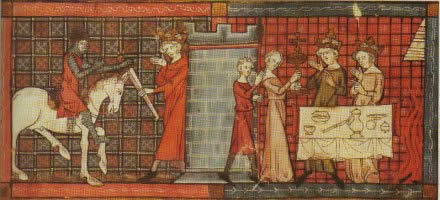
So, back to Percival. Percival eventually came upon the Fisher King in his boat on the river, then to the Graal Castle. There he feasted with the Fisher King. While he was there, he received a sword, he saw the Graal carried through by a maiden, with two pages with candelabras ahead and a second maiden with a carving dish behind, and he saw a lance that bled. He kept silent, remembering Gornemant's gease and taboo, and didn't ask about these things. He stayed the night, and the castle was empty in the morning, so he left, hoping to find the servants of the castle.
Instead, he finds his cousin. She asked him what he saw in the castle and he describes it, answering each of her questions until she asks if he asked the meaning. The conversation shows he knew enough to ask but kept silent. She tells him his question could have healed to King and his silence brought desolation the land.
He proceeds to King Arthur's court. A horribly ugly maiden came and chewed him out:
"Ah, Perceval, Fortune is bald behind, but has a forelock in front. A curse on him who greets or wishes you well, for you did not seize Fortune when you met her. You entered the dwelling of the Fisher King; you saw the lance which bleeds. Was it so painful to open your mouth that you could not ask why the drop of blood sprang from the whim point of the lance? When you saw the grail, you did not inquire who was the rich man whom one served with it. Most unfortunate is he who when the weather is fairer than usual waits fir even fairer to come. It was you, unfortunate man, who saw that the time and the place were right for speech, and yet remained mute. You had ample opportunity, but in an evil hour you kept silent. If you had asked, the rich King, who is now sore troubled, would have been wholly cured of his wound and would have held his land in peace--land which he will never hold again. Do you know what will happen if the King does not hold his land and is not healed of his wound? Ladies will lose their husbands, lands will be laid waste, maidens, helpless, will remain orphans, and many knights will die. All these calamities will befall because of you!" ~The Grail: From Celtic Myth to Christian Symbol, Roger Sherman Loomis, Pg, 40

"...for you did not seize Fortune when you met her." This brings to mind something else Cochrane said, "In fate, and the overcoming of fate is the true Graal, for from this inspiration comes, and death is defeated." "Overcoming of fate" would appear to be the same statement, "seize Fortune", as Dame Fortune was the guise Fate took in the Middle Ages, when Comte del Graal was written. Percival failed to "seize Fortune", failed to "overcome Fate" when he failed to ask about the things he saw, in effect failed to ask about the Graal. Cochrane said the true Graal was fate and the overcoming of fate, and the maiden says failing to ask the question was failing to grasp Fortune. It follows that Fortune, which is Fate, and therefore the true Graal, is obtained by asking the right question, asking the meaning of the Graal. You obtain the Graal by asking its meaning and whom it serves.

Percival failed to ask. He kept the gease and the taboo, and therefore failed to ask the question, failed to grasp Fortune, failed to overcome fate, failed to obtain the Graal. The secret lies in learning when to break the gease and taboo. And in general, the secret to Mystery, to Knowing, Understanding, and Wisdom. To Kether and the Divine.
FFF,
~Muninn's Kiss