Showing posts with label robertcochrane. Show all posts

Wednesday, 26 December 2012

Five Rivers Past the Gates of Death

Last July, I wrote a post concerning death called Close the world, Open the Next: a Requiem for Life, a Soliloquy for Death (Blogger, Wordpress, LiveJournal).  Within it, in a small section concerning the Song Of Amergin, I made the following statement concerning the River Styx:
The Hawk, according to Graves and the myths he connects to the Cliff, is on the Cliffs of Nonacris, in Arcadia (because everything comes back to Arcadia).  From the Cliffs flows the headwaters of the River Styx, one of the rivers of the Underworld.  In some myths, it is the River Styx that Charon ferries the dead across.  Styx is firmly rooted in Death, and is where the gods go to make oaths, swearing them on the waters.  Styx is Hate, and it's followed by Sorrow, the Tear that the Sun lets fall.  Cochrane said, "A Crafter is born not made, or if one is to be made, then tears are spilt before the Moon can be Drawn."  Sorrow and Tears are necessary ingredients to Witch.  The Tears fall for the desolate world, the Wasteland.
To expand a bit on this statement, I'd like to discuss the five main rivers of the underworld discussed in Greek myth.

Styx, Στύξ, in Greek literally means "hate" or "detestation", that which we despise and reject, the abject.

The River Acheron is literally the River of Sorrow, or River of Woe.

The River Cocytus is literally the River of Cries, or River of Lamentation.

This leaves two other rivers, the River Phlegethon, the Flaming River, and the River Lethe, the River of Forgetfulness, or River of Oblivion, or River of Concealment.

It's said Styx loved Phlegethon, but his fire burned her and killed her, that's how she ended up in the Underworld.  Phlegethon is said to coil around the earth, much as Loki's son in Norse mythology does, then flows into the depths of Tartarus.  There, Styx and Phlegethon were allowed to unite, flowing together, fire and water.

The River Lethe is of course the river souls drink from to forget the pains and sorrows of life.  The Eleusinian Mysteries and a few others taught their initiates how to find the pool or river Mnemosyne, Memory, instead.

Styx (Hate) leads to Acheron (Sorrow).  Acheron leads to Cocytus (Tears).  Cocytus leads to Phlegethon (the fire that burns away the chaff).  And Phlegethon leads to Lethe (Forgetfulness) or Mnemosyne (Memory).

But this is easier to see when we think of Styx as the abject, the casting off of what we hate in ourselves, rather than the hate itself.

Through the Gates of Death, we first cast off that which we hated about ourselves in life.  Then we feel the loss of that which we loved in life, this is our sorrow.  This leads to tears, lamenting the loss of all we thought he had in life, after we've cast off both what we hated and what we loved, all our attachments.  But then we burn off even the sorrow and lamentation, leaving nothing but our unbiased memory of what came before.  We then stand at a crossroads.  Do we drink of forgetfulness and lose even the memory of things past, starting with a clean slate, but losing also that which we learned, or do we drink from memory and hold onto that last part of the life we lived before, remembering the lessons and wisdom, learning from them in that which we now enter?

This is paralleled in the Descent of Inanna, of course.

This is of course the course not of just physical death, but of all try initiation.  And it the path we take to fully realize what it is to be Witch.

FFF,
~Muninn's Kiss

Wednesday, 12 September 2012

Taboos and Geases: Before you can advance, you must first withdraw...


Learning T'ai Chi Chuan, I learned a valuable lesson about the often misunderstood Yin and Yang.

I understood them on an intellectual level, from my study of Taoism and Traditional Chinese Medicine.  I knew not to think of Western dualism, the product of Zoroastrian influence.  I've talked before of the descriptions in The Web That Has No Weaver by Ted J. Kaptchuk.  His five descriptions greatly helped me understand Yin and Yang:
  • All things have two facets: a Yin aspect and a Yang aspect.
  • Any Yin or Yang aspect can be further divided into Yin and Yang.
  • Yin and Yang mutually create each other.
  • Yin and Yang control each other.
  • Yin and Yang transform into each other.
These principles describe a concept foreign to most Westerners.  The poetic understanding of the two is a hill on a sunny day, with no other hills or trees or mountains to cast shadows.  Before Dawn, the hill is all in darkness, is all shadow, is all Yin.  As the sun rises in the morning, it hits the Eastern side of the hill.  This is Yang.  The Western side is still in shadow, still Yin.  As the sun rises, the Yang part grows and the Yin shrinks.  Yin transforms into Yang.  by noon, the entire hill is sunny, all Yang, no shadow, no Yin.  But this doesn't last long.  As the sun moves West, the Eastern edge darkens, shadow forms at the base, Yin, then grows as the sunny section shrinks.  Yang transforms into Yin.  As Dusk fades, it is all Yin again.  Yet it's all one hill.  The hill doesn't change, only the ever changing light.  It is Yin changing to Yang, changing to Yin again.  But it's all one, the Tao.

Easy to understand intellectually and to observe, but what does it mean personally, how does it effect me and you specifically, beyond the intellect?  This is what T'ai Chi Chuang taught me.

T'ai Chi is the tent with a ridgepole, with form.  It is always moving, constant movement, constant change.  What changes, though, from what to what?  The forms change, our body, constantly in motion, moving, moving Chi, energy.  It changes, like the light, from Yin to Yang, to Yin, to Yang, and so on.  But what does this mean?  Have you ever tried to move without preparation?  Can you hit without pulling back your fist and have any force?  Can you step without first lifting your foot?  In T'ai Chi Chuan, Yin is pulling inward toward your centre, toward your lower Don Tian, preparation.  Yang is moving outward, away from your centre.  You learn quickly that before you can advance, you must first withdraw, and advancing puts you in the right position to be able to withdraw again to prepare for the next advance.  Yin transforms into Yang then back to Yin again.

That idea of advancing and withdrawing is visible in the Sepheroth of the Tree of Life in Kabbalah.  The two outer Pillars, the Pillar of Mercy and the Pillar of Severity, are named for the middle Sepherah of each side.  The Pillar of Mercy is the Pillar of Chesed, of mercy and loving kindness and forgiveness.  The Pillar of Severity is the Pillar of Geburah, of severity and justice and judgment.  Ultimately, in a base and stripped to the core manner, Chewed is infinite, unlimited expansion.  Geburah is infinite, unlimited restriction.  Geburah is Law, Chesed is Liberty.  Geburah is Yin, withdrawing, pulling inward; Chesed is Yang, advancement, moving outward.

Ultimately, Law (Geburah/Yin) takes one of two forms: a taboo or a gease.  A negative law or a positive law.  A taboo is negative in the sense that it says no, "thou shalt not", it's restrictive.  A gease is positive in the sense that it says yes, "Thou shalt", it's proscriptive.  But both are Law, and both are Yin, bring withdrawal.

At the scale of a large society like most modern societies, and the scale of large organized, taboos and geases are used to control and to prevent people from finding the power and strength and mystic connection that might make them a challenge to that established structure.  This is an extreme use of Law, of Geburah.  This is the legalism so common in organized religion, and the totalitarian tendencies of most government.  The more anarchic elements of society tend toward the other side.  The complete ignoring and breaking of taboos and geases just out of principle.  The "don't tell *me* what to do!" attitude.  They assume all rules are wrong and made to be broken.  Of course, only a few take this to it's complete extreme and break all rules including murder of random people and suicide.  The elimination of all rules, of all Law, is what Chesed as government would be, all is forgiven, all is allowed.

On a smaller scale, the extremes fall away.  Or do in the right context.  A tradition or teacher that operates fully in Chesed tends to become too "fluffy".  The lack of Law tends to lead to a lack of structure and boundaries.  This can make learning from the tradition or teacher very difficult.  On the other extreme, a tradition or teacher that operates fully in Geburah, all Law with no Liberty, where everything that is not forbidden by taboo is dictated by gease.  The lack of Liberty tends to keep all students following the same path, which makes it easier to make sure the right things are learner, but it also stifles creativity and self discovery.

I think the best approach is a balance, more Tipherah, Beauty, than Chesed or Geburah.  The balance between Law and Liberty, Love, leads to Knowledge and Wisdom.  That balance leads to Da'ath, Knowing, to Binah, Understanding, to Chokmah, Wisdom, and on the Divine in Kether,  the Crown.

In this balanced approach, taboos and geases serve three important functions and should not be lightly broken:
  1. They serve as a guideline to keep the group or student all pointed in the same direction. Taboos serve as a map as it were for the path the group is walking or the teacher is leading the student.  This is similar to the use in the Law approach, but less firm, allowing flexibility, a map instead of a wall.

  2. They can serve to protect the student or person new to the tradition. There are very real dangers in any path worth taking, and if you are not prepared, those dangers may cause damage that cannot be undone, physical, emotional, mental damage, or create a road block that prevents them from going forward.  This gives a safety net and buffer as the student moves forward and develops the tools, the skills, the defenses, the weapons to face those dangers and truly to be tried by them.

  3. They create a contrast for later transgression. You need to sometimes learn the rule and learn to follow it before you learn when to break it. And there lies Wisdom and when you've moved past basics, when you can recognize when to break the taboos, and why.  This is ultimately the process of learning when to ask questions and learning to ask the right question.  And finally, to actually ask that question.
This can be seen in Conte del Graal by Chrétien de Troyes, the oldest Graal story we have.  Percival, found wandering in the woods by the woman who chose then to raise him, is enamoured with the knights of King Arthur he sees.  He sets off to become a knight.  Lord Gornemant meets him and looking kindly on him, trains him in the basics, knights him, and sends him on the way, on his own path.  This teacher, this mentor, as he was leaving, made a final statement, a taboo in some ways, a gease in others.  "Qui trop parole, pechié fait."  "Who talks too much, commits a sin."  This statement, though not phrased as either, implies both a taboo and a gease.  The taboo, of course, is, "avoid excessive speech."  The guessed is, "be silent unless it is necessary to do otherwise."

Necessity.  Learning that is Wisdom.  As Robert Cochrane said, "Do not do what you desire, do what is necessary."  Following the taboos and geases is learning the first half, "do not do what you desire".  But that is only half the lesson.  Learning when to break those taboos and geases is learning the second half, "do what is necessary".

Percival learned the first lessen well we see as the story progresses.  There's a set of principles that many trad craft witches I know tote as almost a central Law of Magic.  It is called the Four Powers of the Sphinx.  "To Know, to Will, to Dare, to Keep Silent."  These Powers are found primarily in the writings of Eliphas Lévi and Aleister Crowley, with no real mention before them.  Most people I see quoting them focus on the last, "to be Silent", the very command Gornemant gave Percival.  The context is often either oaths made in relation to initiations (it should be noted that being knighted, as Gornemant did to Percival, is initiation), or in discussions of speaking of your magical practice being giving your power away, that speaking of it is sharing power and therefore diminishing that power.  There is truth in this, but I think we should look more at Lévi's discussion as it is the foundation of later discussion.  He says several things in the Great Secret and Transcendental Magick that should enter the discussion.
"To attain such an achievement it is necessary to KNOW what has to be done, to WILL what is required, to DARE what must be attempted and to KEEP SILENT with discernment."  "When one does not know, one should will to learn.  To the extent that one does not know it is foolhardy to dare, but it is always well to keep silent."  "In order to DARE we must KNOW; in order to WILL, we must DARE; we must WILL to possess empire and to reign we must BE SILENT."
There's a lot in those quotes demanding discussion, but we'll focus on what's relevant to this discussion of taboos and geases.  In the first quote, the phrase "with discernment" sticks out.  Lévi isn't talking about blindly being silent, he's talking about having discernment about when to speak.  As Cochrane said, "I was taught by an old woman who remembered the great meetings - and she took no terrible oath from me, but just an understanding that I would be discreet. She did not require silence, only a description of what I had seen and what I had heard and said when I was admitted. The Gods are truly wise - they know the future as well as the past and they admit not those who would abuse knowledge or wisdom."  This is what Percival needed to learn, as do we.

In the second quote, Lévi is discussing when you're working from a point of partial knowledge.  When you don't know, no matter where you are in the path, you become a beginner again.  In this situation, of course silence is best.  You learn more at that stage from listening than from talking, and until you know enough to ask the right question, to know and dare to speak, you might prevent yourself from learning what you need to know to be able to dare.  Leaving Gornemant, this was where Percival was at.  He didn't know enough to ask yet, so the gease of silence was best.

The last quote gives an order.  First you must know, then you can dare, then you can will.  Will gives you dominion, but silence keeps it.  We're seeing a cycle here.  In the beginning, you are silent until you know enough to ask the right question.  Then you ask and learn more.  But when your knowledge is complete, when you have fully dared and fully willed, you return to silence.  This is discernment, knowing when to ask and when to be silent.  When to keep the taboo against speaking and the gease to be silent, and when to break them and ask.

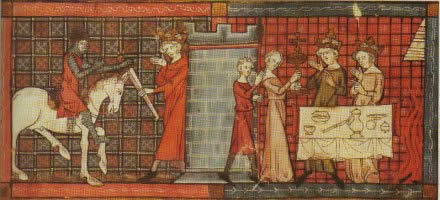
So, back to Percival.  Percival eventually came upon the Fisher King in his boat on the river, then to the Graal Castle.  There he feasted with the Fisher King.  While he was there, he received a sword, he saw the Graal carried through by a maiden, with two pages with candelabras ahead and a second maiden with a carving dish behind, and he saw a lance that bled.  He kept silent, remembering Gornemant's gease and taboo, and didn't ask about these things.  He stayed the night, and the castle was empty in the morning, so he left, hoping to find the servants of the castle.

Instead, he finds his cousin.  She asked him what he saw in the castle and he describes it, answering each of her questions until she asks if he asked the meaning.  The conversation shows he knew enough to ask but kept silent.  She tells him his question could have healed to King and his silence brought desolation the land.

He proceeds to King Arthur's court.  A horribly ugly maiden came and chewed him out:
"Ah, Perceval, Fortune is bald behind, but has a forelock in front. A curse on him who greets or wishes you well, for you did not seize Fortune when you met her. You entered the dwelling of the Fisher King; you saw the lance which bleeds. Was it so painful to open your mouth that you could not ask why the drop of blood sprang from the whim point of the lance? When you saw the grail, you did not inquire who was the rich man whom one served with it. Most unfortunate is he who when the weather is fairer than usual waits fir even fairer to come. It was you, unfortunate man, who saw that the time and the place were right for speech, and yet remained mute. You had ample opportunity, but in an evil hour you kept silent. If you had asked, the rich King, who is now sore troubled, would have been wholly cured of his wound and would have held his land in peace--land which he will never hold again. Do you know what will happen if the King does not hold his land and is not healed of his wound? Ladies will lose their husbands, lands will be laid waste, maidens, helpless, will remain orphans, and many knights will die. All these calamities will befall because of you!" ~The Grail: From Celtic Myth to Christian Symbol, Roger Sherman Loomis, Pg, 40
"...for you did not seize Fortune when you met her."  This brings to mind something else Cochrane said, "In fate, and the overcoming of fate is the true Graal, for from this inspiration comes, and death is defeated."  "Overcoming of fate" would appear to be the same statement, "seize Fortune", as Dame Fortune was the guise Fate took in the Middle Ages, when Comte del Graal was written.  Percival failed to "seize Fortune", failed to "overcome Fate" when he failed to ask about the things he saw, in effect failed to ask about the Graal.  Cochrane said the true Graal was fate and the overcoming of fate, and the maiden says failing to ask the question was failing to grasp Fortune.  It follows that Fortune, which is Fate, and therefore the true Graal, is obtained by asking the right question, asking the meaning of the Graal.  You obtain the Graal by asking its meaning and whom it serves.

Percival failed to ask.  He kept the gease and the taboo, and therefore failed to ask the question, failed to grasp Fortune, failed to overcome fate, failed to obtain the Graal.  The secret lies in learning when to break the gease and taboo.  And in general, the secret to Mystery, to Knowing, Understanding, and Wisdom.  To Kether and the Divine.

FFF,
~Muninn's Kiss

Wednesday, 14 March 2012

On Initiation, Fate, and Law

The following is adapted from an answer I gave to a post on a list.  I've edited it to only include my one words and ideas and for clarity now that the context is removed, and to remove things that shouldn't be said publicly.  I'm going to ramble a bit, touching on a large number of subjects.  Just remember, I don't know anything, just like everyone else.  ;-)  So take it with a grain of salt and your mileage may vary.

Sir Galahad as conceived
by George Frederick
Watts (1817–1904).
So, first, Initiation.  Though Feri initiation is unique to Feri, as Victor developed some key parts of it after his own initiation, at its core, it's the same as Initiation found the world over, from the shamans of Northern Asia to the Greek Mystery Religions to the native tribes of Australia, North America, and South America.  And everywhere in between.  It's the Welsh vigil on a hill in the dark of night in a storm alone with the spirits.  It's the spirit journey to find yourself in the smoke in the forests of the Amazon.  It's the Christian baptism.  It's Odin cutting out his eye for wisdom, or him hanging upside down from the world tree for nine days, a spear in his side, a sacrifice of himself to himself.  It's the ordeal of the Graal Knight, alone seeking the Castle Perilous, having to answer the question, "What is the secret of the Graal (or what is the meaning of these things), and whom does it serve?", which is the same question as, "Who is this flower above me?  What is the work of this god?  I would know myself in all my parts."1  Ultimately, in whatever form, Initiation is two things that are really one.  First, it is death and rebirth, torn apart by the spirits and put back together, the same person but changed, never to return.  Second, marriage to the gods and spirits, the becoming a Priest/ess.  As Cora says in Fifty Years:
"Initiation does not make you a full-blown highly trained Witch. In initiation you literally marry the Goddess, her dual consort and the Gods, whether you are male or female. In speaking to her priest the Goddess says, "I love you with the same love with which a mortal woman loves you, but raised to the power of divinity." To her priestess she says, "I love you with the love with which a man or woman loves you, but raised to the power of divinity." Always remember that in the deepest sense the man you love as life companion or in passing is your son, brother and lover and should be treated with love and respect as yourself and other half."2
This, of course, begs the question of what is a Priest/ess.  Rather than make this too long, here's my post about the subject, my own experience and ideas, of course, not "Orthodox Feri", and almost a year ago now, so my thoughts may have changed some:

http://muninnskiss.grimr.org/2011/06/on-priests-priestesses-bridges-and.html 

Back to my list above, the idea of Initiation as the ordeal of the Graal Knight leads me to the next discussion, Karma.

Lady Justice
First off, before I explain that, I'll say this, personally, I don't believe in Karma, the Western broken version or the Eastern version.  The Western version is really an attempt to take the modern Christian idea of justice verses grace, or more accurately, the Medieval ideas of Lady Justice and Lady Liberty which forms much of the modern Western mythology of Government (Lady Fate got lost somewhere, as un-Christian), and make it less "Christian" by rebaptising it as Karma.  It is personified as that which spanks us if he do bad and rewards us when we do good, basically the way many modern people view the Christian god.  Though even the Medieval concept was different from that.  Lady Justice is blind.  She weighs the deeds but has no personal stake in it, no personal connection to the individual or their actions.  This is much closer to the Eastern (original) version of Karma, which is impersonal and very much a cause and effect, just on a level that's both physical (Yin) and spiritual (Yang).  Remember, Yin and Yang in China are not two opposing forces but are two side of the same thing, connected, impossible to separate, and the Yin side can be further divided in Yin and Yang, and likewise the Yang side, a continuum, rather than duality.  Same thing in Karma, which originated in the Indian Subcontinent.  Science sees physical cause and effect.  Karma includes those, but allows for spiritual and non-linear effects.  But Karma is a principle in the world, not a god or spirit or entity like Western Karma tends to be seen.  Karma is more like Fate, but doesn't really fully describe the way I see Fate.  Which brings me back to the Graal.

Robert Cochrane said:
Some groups seek fulfillment in mystic experience - this is correct if one does not forget the duty of 'involvement' - the prime duty of the wise. It is not enough to see The Lady, it is better to serve Her and Her will by being involved in humanity, and the process of Fate (The single name of all God's is 'Fate'). In fate, and the overcoming of fate is the true Graal, for from this inspiration comes, and death is defeated. There is no fate so terrible that it cannot be overcome - whether by a literal victory gained by action and in time, or the deeper victory of spirit in the lonely battle of the self, Fate is the trial, the Castle Perilous in which we all meet to win or to die - Therefore, the People are concerned with Fate --for humanity is greater than the Gods', although not as great as the Goddess. When Man triumphs, fate stops and the Gods are defeated - so you understand the meaning of magic now. Magic and religion are aids to overcome Fate, and Fate is a cradle that rocks the infant spirit.

Now you know what 'witches' are.3
To me, this is the heart of witchcraft, of magic, of Feri (though it's from a different stream).  "In fate, and the overcoming of fate is the true Graal, for from this inspiration comes, and death is defeated."  How is death defeated?  In surviving it.  That's what initiation is.  But, on to Fate.  What is Fate?  "The single name of all Gods".  Elsewhere, Cochrane talks about cords and their use in witchcraft (which I'll get back to).  There, he says, "They appear to have originated from the woven strands of Old Fate, the major deity of all true witches."4  "The major deity of all true witches."  This is important I think.

I don't see Fate much in Feri writing or teaching, but She's there, both as the Star Goddess, and as the Three Mothers (the term used in Clan of Tubal Cain, a British witchcraft tradition), the Three Hooded Ones.  I've only seen Feri references to the Hooded ones (often called the Cowled Ones in British traditions) in two Feri poems, so I won't dwell heavily on the Feri lore, but I will look at some other places.

There's a Greek creation with that tells of Chronos and Ananke, serpentine with three heads each (Chronos', Time's, heads are obviously the past, the present, and the future; Ananke's are Fate, Destiny, and Necessity) curled around an egg.  Their movement around each other broke open the egg and Eros was born, along with the mud that solidified into Gaia, and the water that became Oceanus.  From Eros came Nyx and Erubus, Night and Darkness, who gave birth to Day and Light.  Chronos and Ananke came from Chaos, but those three seem to always have been there.  The movement of Chronos and Ananke's coils keep the heavens and earth turning, the stars and planets (including moon and sun) moving, the seasons changing, the tides turning, the lives of gods and men moving forward.  Time and Fate are the two moving forces of the universe that even the gods are subject to.

The Moirae
But closer to the topic, with Zeus, Ananke had three daughters (or Chronos with Nyx, depending on the story), the Moirae, the Fates.  Clotho spins the thread of our life, setting the initial path. Lachesis measures the thread, determines what will happen during the lifetime.  Atropos cuts the thread, determines the death of the person.  Even the gods are subject to these three (except Zeus in some versions, as their father).  But man can overcome their Fate, hence why the demigods like Perseus and Hercules are so important, with the power and strength of the gods but the ability to overcome Fate like men.  (The Three Mothers are also seen in the Furies and the Graces.)

The Norns
In Norse belief, we find the Norns (there are many norns, but there are three main ones), very similar to the Fates of Greece, three daughters of giant-kin who control the Threads of Wyrd, with power over gods and men.

They appear many other places in Indo-European myth, from Ireland to India, and other places as well.  Even in Jewish Kabbalah with the Three Mothers, Shin, Alpha, and Mem, Fire, Air, and Water.  You even find them in Taoism if you know where to look.

But where I was going with this is Wyrd.  In my belief, Wyrd is the Threads of Fate that bind us together and determine each of our paths, and the paths of the universe.  It is the Chinese web that has no weaver, it is Buddhist and Hindu Karma, it is Greek Fate, it is the Soul Spark of Kabbalah.  Imagine a huge web, stretching forever in all directions in space and time.  There are an infinite number of threads, an infinite number of paths, an infinite number of possibilities.  But there are knots tied in this web, in these threads.  These knots limit the options, direct where things can go, control the past and the future.  Withing each of our Godselfs, there is a bundle of Threads at the middle.  These are our Wyrd, our Fate.  These Threads connect to the rest of the web.  These Threads determine our options, our choices, our future.  We received them from our (physical and spiritual) ancestors, and they came tied in knots to other threads, limiting us.  But each action we take, each world spoken, each choice we make, binds new knots or looses old knots, limits or expands our options.  Cause and effect.

I talked more on Wyrd and webs in this blog post, if you're interested:

http://muninnskiss.grimr.org/2011/10/on-centres-actions-webs-and-spiders.html

Getting back to "In fate, and the overcoming of fate is the true Graal, for from this inspiration comes, and death is defeated."  Most people go through life on autopilot, essentially.  They let Fate dictate to them their choices.  They think they are deciding, but they're really just following the Threads, letting the existing knots determine the outcome.  Eastern Enlightenment, Western Gnosis, is the realization of those Threads and our ability to change them.  To step back from the web and look at it and consciously change it, to untie a knot here, tie a knot there, and change the course of history.  To write your own Fate.  This is truly what witchcraft is, the binding and loosing of the Threads of Fate.  Once you move past letting Fate dictate, you enter the realms of Destiny and Necessity.  Destiny is what Crowley was talking about when he talked about True Will.  "Love is the Law, Love under Will."5  It's what we can truly be if we take the reigns of our life instead of submitting them to Fate.  As the Feri Maxim goes, "never submit your life force to another."  Necessity is what Cochrane talks about when he says in his witch 'Law', "Do not do what you desire - do what is necessary."6  Once we can see the web and know we can make the decisions, that we can create Change, we can see clearly what is necessary to accomplish what needs to be done.  This is fully integrated, of course.  It takes Fetch, Talker, and Godself to truly see the web, and see the Necessity.

And, the mention of Love being the whole Law brings me to the next subject.  Love and Law are of course both part of the Pearl Pentacle in Feri.  But they can't exist without Knowledge, Wisdom, and Liberty/Power, either.  To just act without thought means there is no Knowledge involved.  No Point can be left out, or you are out of balance and can't act rightly.

Sophia
Going back to the discussion of Lady Liberty and Lady Justice, ultimately Dame Justice in Medieval thought is Law in the Pearl.  Dame Liberty is Liberty/Power, of course.  But Dame Wisdom, Sophia of the Greeks and Gnostics, got lost along the way.  The White Goddess of Robert Graves fame has become an integral part of modern paganism and witchcraft (both trad craft and Wicca), but the Black Goddess, Sophia, the deeper mysteries, has been ignored by most.  The White Goddess really stands as Fate and the Three Mothers, modernly seen as the Maiden, the Mother, and the Crone, though this misses a lot.  But I'm on a tangent that I can't pull back, so I'll leave this one for now.

Law, Dame Justice, as relating to Dharma, the Laws that define how the universe work, is not really separate from Fate.  It is the workings of Chronos and Ananke, of Time and Fate/Destiny/Necessity that govern the things of the universe.  None of the Points function in isolation, they are really one and the same, just as they are in the Iron Pentacle.  Fate, Karma, is the movement, the Yin.  Law, Dharma, is the stillness, Yang.  Both come from the Tao but aren't the Tao, they are part of the Te of the Tao, the virtue, the properties if you will.
The Tao begot one.
One begot two.
Two begot three.
And three begot the ten thousand things.7
The Tao and the One, are God Herself, the Star Goddess, the Uncreated, the Fountain of All, the Nagara.

The Two of course, are Yin and Yang, the Divine Twins, the Tvennr, their constant Dance as Lovers and Fighters being the constant change in the world, Chaos, from which Chronos and Ananke proceed.

The Three are the Three Mothers, the Three Cowled Ones that proceeded the gods, the Grimr.  They are seen are the three heads of Chronos and the three heads of Ananke.  They brought Order to the Chaos, though not stability, for they are always in movement.  In Kabbalah, the Three Fathers come from the Three Mothers, though they are really the same.

The Ten Thousand Things is the Chinese poetic description of all that is.

Of these Ten Thousand Things, we find seven, the Guardians, the Watchers, the Seven Stars in the Sky, the Vordr.  They are stillness and the foundation.  The static forces that hold the universe together if you will.  The ultimate teachers.  If the Three Mothers are Fate and Karma, the Guardians are Law and Darma.

To the next subject.  As I said above, to act in a deliberate way, a way that creates Change rather than lets Fate determine the course, requires all parts of us ("I would know myself in all my parts").  There tends to be an emphasis in Feri to steer away from Talker, seeing Talker as bad, but this is mostly reactionary to a culture where Talker rules.  Talker has a purpose and is necessary.  Fetch cannot plan, as Fetch has no concept of Time.  Fetch only wants what she wants and wants it now, has no ability to abstain or say no to desires.  Talker is needed for these.  But Talker isn't always right, either.  There is a time to plan and a time to act without thought or planning.  There is a time to abstain and a time to feed your desires.  Both are necessary and shouldn't be ignored.  And Godself understands the big picture of the universe, but has little ability to understand the little things that make up life.  Godself without Fetch can't meet the needs of the body and souls.  Godself without Talker can't make the little discussions that can get us to the ultimate Goal, the Graal.
To every thing there is a season, and a time to every purpose under the heaven:
A time to be born, and a time to die;
A time to plant, and a time to pluck up that which is planted;
A time to kill, and a time to heal;
A time to break down, and a time to build up;
A time to weep, and a time to laugh;
A time to mourn, and a time to dance;
A time to cast away stones, and a time to gather stones together;
A time to embrace, and a time to refrain from embracing;
A time to get, and a time to lose;
A time to keep, and a time to cast away;
A time to rend, and a time to sew;
A time to keep silence, and a time to speak;
A time to love, and a time to hate;
A time of war, and a time of peace.8
Hmmm, I said I'd come back to Cochrane's discussion on cords.

He starts out with:
Mrs. Basford has raised an interesting point about the real purpose of cords, harvest twine, string dolls, etc. They appear to have originated from the woven strands of Old Fate, the major deity of all true witches. They are, of course, the origin of such descriptive terms as "spellbinders." When worked up properly they should contain many different parts--herbs, feathers and impedimenta of the particular charm. They are generally referred to in the trade as "ladders," or in some cases as "garlands," and have much the same meaning as the three crosses. That is they can contain three blessings, three curses, or three wishes. A witch also possesses a devotional ladder, by which she may climb to meditational heights, knotted to similar pattern as the Catholic rosary.

I began a blog post on the subject of roots that included a discussion of blessings and curses, binding and loosing, but it expanded into an article I'm going to submit to a magazine so was never posted, so I'll include an excerpt here:
There are basically two ways to do magic.  You can bind or you can loose.  You can curse or you can bless.  Both ways can be used to do the same thing, if you're clever and cunning.  In healing, you can either bless (improve the patient's ability to fight off the infection or to heal the damage) and loose (release the patient from the illness), or you can curse (kill the infection) and bind (hold back the infection or attacker to give room to heal).  It is hard to bless and loose from darkness, and hard to heal and bind from light.  But we both have both in us, as do all things, the Twins in the Great Dance, Shining Bright One and Shadowy Darkling.  We can use our darkness, our impurities, our demons to heal, just as much as we can use our light, our purity, our innocence, our angels.  While plants and woods like aspen or apple might be used in the loosing and blessing way, blackthorn, and the poisons I listed above, usually comes from the other side, killing the infection, removing the cause.
The wording Cochrane uses is important here, I think.  "They appear to have originated from the woven strands of Old Fate, the major deity of all true witches."  The web of the Threads of Fate isn't just pathways, it is Herself.  The web isn't just a metaphor, it is the Truth behind what we see, the Brahma behind Maya.  When a witch takes objects and ties them into a cord, s/he is taking the physical "reality" and binding the Threads of Fate, the "stuff" of God Herself, around that reality, forcing a change.

Cochrane says later:
Basically the cords of binding, as used today, are worked upon with mistaken enthusiasm. Originally they were cords of Fate, woven and bound into a charm for a defined purpose. Sometimes shaped into a semblance of the object or person to be influenced, they were also hung on a gatepost or nailed near to the object or person, preferably in a public place, as an indication of intent. In an Italian spell, the ladder is actually placed in the bed of the person to be enchanted. A beautiful witch ladder, incidentally, was once found in a church belfry: presumably one of the Old Craft could not sleep late on Sunday mornings because of the racket of the bells!
Charms made this way have interesting ramification in understanding Wyrd and Fate.  You can read the whole article (originally published in 1965 in Pentagram)  here:

http://www.1734-witchcraft.org/cords.html

Anyway, I've rambled enough.  Hopefully you find some kernels of grain among these tares.

FFF,
~Muninn's Kiss

1 Flower Prayer found in Feri, originally from KaHuna
2 Fifty Years in the Feri Tradition by Cora Anderson, available from Harpy Books at http://www.harpybooks.com/Catalog/Fifty-Years-in-the-Feri-Tradition.shtml or Amazon at http://www.amazon.com/gp/product/B0006RMANM/ref=as_li_ss_tl?ie=UTF8&tag=grimr-20&linkCode=as2&camp=1789&creative=390957&creativeASIN=B0006RMANM
3 From Robert Cochrane's second letter to Joe Wilson, written in 1966, found here: http://www.1734-witchcraft.org/lettertwo.html
4 From On Cords by Robert Cochrane, originally published in 1965 in Pentagram, available here: http://www.1734-witchcraft.org/cords.html
5 From Liber AL vel Legis, the Book of the Law, by Aleister Crowley, found here: http://www.sacred-texts.com/oto/engccxx.htm
6 From Robert Cochrane's sixth letter to Joe Wilson, written in 1966, found here: http://www.1734-witchcraft.org/lettersix.html
7 From section 42 of the Tao Te Ching, originally written by Lao Tzu.  This translation is by Jonathan Star.  A copy with his translation can be found at http://www.amazon.com/gp/product/1585426180/ref=as_li_ss_tl?ie=UTF8&tag=grimr-20&linkCode=as2&camp=1789&creative=390957&creativeASIN=1585426180
8 Ecclesiates 3:1-8, King James Version of the Bible, formatting mine.  In context, see http://www.biblegateway.com/passage/?search=Ecclesiastes+3&version=KJV

Sunday, 17 April 2011

In Response to Rethinking the Watchtowers...

This and the previous post were replies to an email on a list, though I've removed the parts that are relevant only to the message I was replying to.  I liked how I said what I said and figured I'd share it with anyone who wants to read it.


This is in regards the the article Rethinking the Watchtowers by Mike Nichols.  It is from a Wicca perspective.  The email discussion about it was in a Feri context.  The original site is no longer up, but it can be read here:

http://witchnest.blogspot.com/2009/07/rethinking-watchtowers-or-13-reasons.html

Some of what he says I agree with and some I don't.  I like Air in the North, but I like Fire and Earth differently than his arrangement.  When I've called on the Feri Guardians, I've used the associations V gives, but they aren't the arrangement I'm most comfortable with.  I prefer the arrangement that is "traditional" in the traditions that draw from Robert Cochrane's letters and practices, like 1734 and the Clan of Tubal Cain.  The explanation below is mostly my own understanding, based on what I've read, what I've experienced, conversations with others, and my own musings, nothing official.  So this isn't all my original thoughts, nor is it all what I was taught from a specific authoritative source.  I'll explain why I put "traditional" in quotes, at the end.

http://www.1734-witchcraft.org/gillsthree.html

The associations I'm talking about are drawn from RC's Basic Structure of the Craft, which is essentially a creation myth, but sets up a mythos used in rituals and rites.  It describes Night having seven sons who created seven worlds.  Four of these are the Wind Gods, which are the Four Winds from the four directions.  Tettens is in the North, the North Wind, and is Woden, amongst other things.  He is described as Air.  In the East is Lucet, the King of Light, who is Fire.  These two are the Divine Twins, "Lucet and Tettens are the Twins, the Children of Night and the Serpent, brothers and some say one and the same person. Fire and Air, growth and decay. One looks forward, the other backward. One creates, the other destroys, Castor and Pollox."  In the South is Carenos, who is fertility, Earth.  In the West is Node, Sleep and Wisdom, the God of the Sea, Water.

So Air is in the North, and is the colour black.  This is the cold North Wind, which brought all the winter storms to the British Isles.  For North is also Winter and Midnight, which matches what was said in the article, for Winter is dark, and the further north you go, the darker and the longer the nights, until there is only night, only Midnight.  Hence the colour black.

Fire is in the East, and is the colour red.  The sun, which is Fire, and the masculine principle in the world (though the sun is pulled by a female in Norse belief and the moon my a male; there's a lot of secrets in that), rises in the East (as does the moon, but that isn't important), and many ancient cultures believed his home was in the East.  Cochrane equated the Masculine Mysteries with the sun and Feminine Mysteries with the moon, which are East and West.  Lucet, the King of Light, brings the sun, which brings light.  Life was said to come from the East and from the sun.  Fire is red of course.

Earth is in the South, and is the colour white.  Earth is feritility, as Carenos is fertility.  The further south you go in Britain, the more fertile, in general.  Wessux is definitely more fertile than the Scottish Highlands.  The soil in the southern part of Britain are chalk, which is white of course.  The use of chalk in the Craft is very important.  Also, white is light, and noon is the brightest part of the day.  I'll get to that in a bit.

Water is in the West, and the colour is grey.  The moon, as we mentioned, is Water and feminine.  The moon sets in the West (as the does the sun, but that isn't important), and many ancient cultures believed she had her home there.  The house of the moon, the Gates of the West, are the Gates of Death, the way to the Underworld.  The dead were said to travel across the great western sea, the Atlantic Ocean, when they died, traveling with the moon.  Water is in the West not because you couldn't see land from the West coast of Britain or could from the East coast, but because it was "known" that past Ireland, there was only water and the land of the dead, which was under water.  Grey is for twilight, between day and night.  I;ll get to that in a second.

North, East, South, and West are not just Air, Fire, Earth, and Water.  In fact the four elements are one of the least important associations with the Wind Gods and directions, just as the Feri Guardians are so much more than elemental forces.  1734 doesn't work in a Circle in the way Wicca and Ceremonial Magic does.  1734 works a compass (notice, "works a" not "works in a").  The compass isn't related to protection or controlling anything like circles in Ceremonial Magic.  What does a compass do?  It points the way.  But compass comes from a different meaning, to surround.  The four directions surround, so became called the compass, and the device that points was named for it.  Thorn likes to use the phrase for God Herself, and also for Witch, "the centre which is the circumference of all."  This is the compass.  When you stand in the middle, you are Witch, you are the centre, but you are also the world, the circumference.  But, anyway, I digress.  The compass places in in time and space, orientates you.  The directions are also times and dates.  North is Midnight, and Winter Solstice.  East is Sunrise, Dawn, and Spring Equinox.  South is Noon and Summer Solstice.  West is Sunset, Dusk, Twilight, and Autumn Equinox.  And of course, there isn't only four directions.  Northeast is Candlemas, Imbolc, and the point between Midnight and Dawn.  Southeast is Roodmas, Beltane, and mid-morning.  Southwest is Lughnassadh and mid-afternoon.  And Northwest is Samhane and mid-evening.  And you can put other points on the compass.  But the compass doesn't stand still.  It can be rotated.  It spins.  Like a castle spinning without moving.  Time and space move.  They aren't static.  Where are you and when are you when you're in the compass?  That is a very good question.

Which brings me to my last point.  I say it's the "traditional" arrangement, because it doesn't stand still.  You can place any direction, any element, any hour, any date at North and it changes everything.  Regardless which order you use or which placement, experiment.  North determines the feel of the compass.  Each element has specific associations.  Maybe why I like Air in the North is because I have always had an affinity to Air and Wind.  I worshiped a wind goddess when I was younger and would call up a strong wind at will.  And Air is inspiration and intellect, and I tend to live in my intellect much of the time, as you can probably tell from these two posts.  In a dream back in February, I was made a priestess and they painted yellow tribal patterns on my skin and white clothes.  Yellow is ofter associated with Air and Intellect.  But I digress again.  What to place at North depends on the work you are doing.  Some workings work well with Air at North and Earth at North is just wrong for that working.  But others Earth is best.  So the best thing is to think throw the correspondences and associations, experiment, and get a feel for it.  Magic and witchcraft are Art.  The intellectual thoughts, the techniques, the traditions, the teachings, all the knowledge in the world, can help you plan and give you ideas, but practice and a feel for it are ultimately what matters.  Listen to Fetch and Godself, don't depend only on Talker, like I tend to.

FFF,
~Muninn's Kiss

Faerie Nation Mag