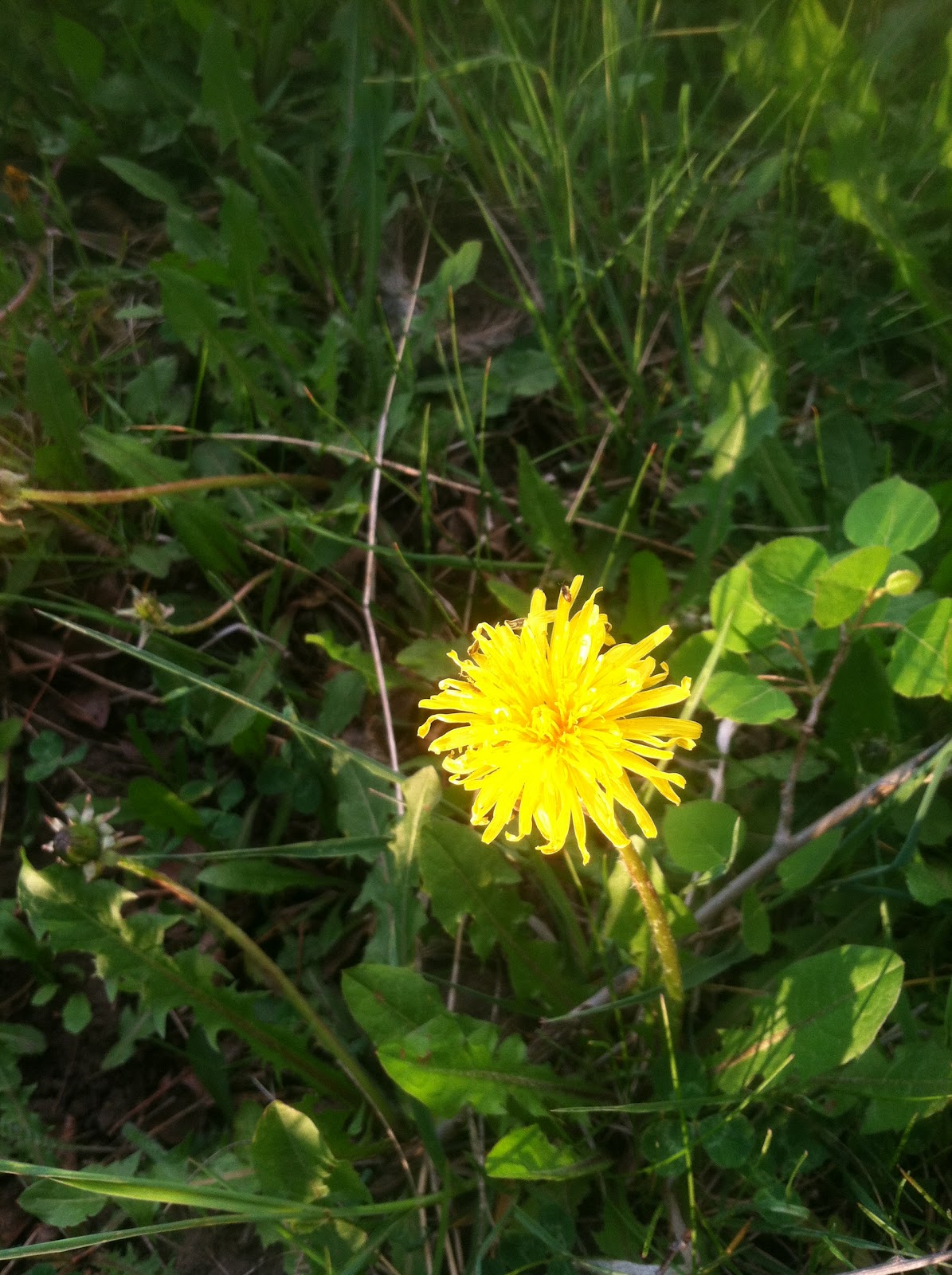
Going back through my old posts, I've written very little about either the Summer Solstice or Winter Solstice. I seem to be either busy or distracted around those times of year. What do I do on either solstice? Very little, actually. Around Winter Solstice, I have Christmas celebrations I've always done, but around Summer Solstice, neither me nor my family has had any traditions, celebrations, beliefs, or anything that acknowledged that this time of year had any importance, let alone power.
My sister, when she lived in New Mexico, during her time in the desert, celebrated both solstices. They were important to the people there. When she moved to Alaska, where the change of the seasons have a lot more impact, she expected the two holidays would also be very important. She reached her first Summer Solstice, and no one did anything. She was very confused. What she found out is the Winter Solstice means light is returning, and is greatly celebrated, but the Summer Solstice marks the beginning of the decline of sunlight, leading to the dark long winter, and people don't find anything to celebrate in that. Not related to the solstice, but I liked a quote from her this week, "Something about the desert makes you believe in every possible spirit or force; something about the great north makes you believe in nothing but the earth."
While the equinoxes are about balance, equal day, equal night, Spring and Autumn, the solstices are times of extremes, longest night and shortest day, shortest night and longest day, Summer and Winter, hot and cold. This plays out in Yin and Yang of Taoism, Chinese folk religion, and Traditional Chinese Medicine. If you take an eight foot (using the Chinese measurement of a foot) and measure the length of the shadow each hour of each day and plot them on a circle, you end up with the Tao-Chi symbol, the symbol everyone thinks of as Yin and Yang, with the two intertwining paisleys or fish, one white and one black. The Yang part of the year starts at the Winter Solstice and is the light part of the year. It starts out as a point, with darkness, Yin above it, then grows until Summer Solstice, where the old Yin disappears and the new Yin begins as a point. Likewise, the Yin part of the year starts at the Summer Solstice and is the dark part of the year. Winter Solstice is the extreme point of dominant Yin, Yang being at its minimum. But Yin and Yang are a cycle. When Yin rules, Yang is born, the son born from the mother. And he grows until he rules at Summer Solstice. Summer Solstice is the extreme point of dominant Yang, Yin being at it's minimum. But she will grow again.
 |
|
 The Web That Has No Weaver

helped me to understand Yin and Yang outside the Western dualistic way of looking at them. I had read the
Tao Te Ching
when I was younger, and the
I Ching
, but never really separated what I read from the Western thought I had grown up with. I grasped it when I read the five principles the author gave for Yin and Yang. And understanding Yin and Yang is essential to understanding Chinese thought. I posted these on Twitter a bit back:
- All things have two facets: a Yin aspect and a Yang aspect.
- Any Yin or Yang aspect can be further divided into Yin and Yang.
- Yin and Yang mutually create each other.
- Yin and Yang control each other.
- Yin and Yang transform each other.
If you don't get what these are trying to say, please either ask me and I'll expand on them (eventually I will in separate posts anyway, but not now), or, better yet, get the book and read the first essay, Medicine East and West: Two Ways of Seeing, Two Ways of Thinking. It is an excellent book, and that first chapter is very profound, describing the foundation on which the rest of the book is built.
This understanding of Yin and Yang has greatly influenced my understanding of the Divine Twins in the Feri tradition of witchcraft. And the Divine Twins are fundamental in my understanding of the universe. It is the Dance of the Twins that creates and destroys, that is what makes up our universe. They are Yin and Yang, opposites, yes, but also one. There is not one without the other, and neither function independently. It is their interplay that defines all things.
Tao produced the One.
The One produced the two.
The two produced the three.
And the three produced the ten thousand things.
The ten thousand things carry the Yin and
embrace the Yang and through the blending
of the Qi they achieve harmony.
~Tao Te Ching, Chapter 42
When the West looks at an event, they look for cause. Everything is cause and effect. A leads to B leads to C. The search that lead to Western science is the search for the Causae Causantes, the cause of the cause, the reason of the cause, the originating cause. We want to know what happened first, what started it all. And when we look at events in our lives, we look for why, not what. My stomach is sick today. I've been thinking about the scallops I ate last night as a cause, instead of thinking, what's wrong now?
When the Chinese look at an event, they want to understand the state in the moment. What is out of balance now. What does the event mean now. They don't not believe in cause and effect, they just mostly find it irrelevant. The title of the book, The Web That Has No Weaver, makes the point well. In the West, we always had our weavers: the three Fates, the three Furies, the three Norns (and all the lesser norns), Ananke, Necessity, Fate, Destiny, and many more besides. Wyrd/Fate/Destiny/Necessity, by whatever word and whatever name, have always played a big part on the Western psyche. But this "who" isn't important to the Chinese. It's the web not the weaver that matters. It is a dance, not a chain of events. For my stomach, the cause would be irrelevant, what matters is what it out of balance at the moment that can be balanced to fix the problem.
But I digress. The Winter and Summer Solstices are Yin and Yang, the Divine Twins. The Divine Twins are the Winter and Summer Kings, death and rebirth, sacrificial kings, consorts to God Herself, the White Goddess, who is also the Black Goddess. There's three ways to divide the year for the Winter and Summer Kings. One is using Samhain and Beltaine. The Summer King is born on Beltaine and is sacrificed on Samhaine, when the Winter King is born and takes over. Or the Summer King is born at Midsummer (Summer Solstice, well, the solstice is June 21st, Midsummer is St. John's Night, the 23rd, the Eve of St. John's Day) and dies at Midwinter (Winter Solstice), when the Winter King is born. Or is it the other way around? Or the third is a mix. The Summer King is born at Beltaine, is crowned and wed to Herself at Summer Solstice, and is sacrificed at Samhain, reborn as the Winter King, who is crowned and wed at Midwinter. I like this latter best. Regardless how you see them, the point is a cycle with the Twins constantly changing which is in control, like the spirals of the Tao-Chi.
So, here in the Northern Hemisphere, we reach today the high reign of the Summer King, Yang is in control and Yin just a point, the Winter King dead or dying. The sun is directly over head (well, further south it is, but here in Wyoming, it is at its highest point). To the Jew, this is the point where the sun stands still and shines evenly on everyone, a point of no shadow (for shadow is the Winter King). That point of standing still is a liminal point. And all liminal points are important and should be noted. The Summer King reigns supreme for a moment, his power growing until then, it receding from then. Until today, he was gaining power, and though he finally seized it, he can't hold it, and his power deceases from here. The Winter King takes back a little each second, each moment, each hour, each day. For neither King can rule supreme for more than a moment for their power comes from Herself, not from themselves, and She shares it with both of them.
Many people celebrate Midsummer differently. The day varies as does the name, but like all the different holidays around Midwinter, around the equinoxes and the "quarter-quarters", it seems a natural time to celebrate. Some celebrate for religious reasons, some just for fun. Some practice magic on this day (or Midsummer's Eve), while others use scientific instruments to observe the sun at its highest point.
 |
"John the Baptist and Jesus"
cast bronze by Lawrence Plowright.
Image from Plowright Studios. |
In many branches of Christianity, including Eastern Orthodox and Roman Catholic, the solstices are very much a time of the Divine Twins and the Two Kings, here in the form of Jesus and John the Baptist. Jesus' birth is celebrated on December 24th, the date of the Winter Solstice before the changing of calendars shifted the solstice back three days. John was born when Mary was three months pregnant with Jesus, so six months before Jesus was born. So John's birth was conveniently placed on June 24th, which was the Summer Solstice. John and Jesus very much are the Winter and Summer Kings. John's ministry came first, a ministry of repentance and water baptism. It was Geburah, Judgement, the harshness of Winter. It is the Baptism of Water, birth from the woom, Yin. Yin is earth and Yang is heaven. In John 3:31, John the Baptist says, "He that cometh from above is above all: he that is of the earth is earthly, and speaketh of the earth: he that cometh from heaven is above all." But as Jesus' ministry grew, John's receded. As John the Baptist said concerning Jesus in John 3:30, "He must increase, but I must decrease." And John was sacrificed first, the sacrificial king, beheaded. Jesus' ministry was one of love and forgiveness, and fire baptism. It was Chesed, Mercy, the growth of Summer. It is the Baptism of Fire, Baptism of the Holy Spirit at Pentecost, being born of spirit, born of heaven, Yang. Jesus said in John 3:5, "Except a man be born of water and of the Spirit, he cannot enter into the kingdom of God." Both Water and Fire, both Winter and Summer, both Yin and Yang, but John and Jesus, are needed. They can't be separated. And the year turns, first John, then Jesus, then John again.
 |
Goddess of Fire -
both sacred fire
and domestic.
(Hestia/Vesta).
Image from
True Time Tales. |
Fire and Water are interesting in the celebration of the Summer Solstice. The two most common practices you find are the burning of bon fires, often involving jumping over them, a topic in and of itself, and the visiting of water wells. Fire and Water. In the West, we tend to think of Fire as masculine and Water as feminine, but even in the West, it doesn't always hold up. Hestia to the Greeks and Vesta to the Romans was goddess of the hearth and the hearth fire. In Vesta's temple, a fire was kept burning eternally by the Vestal Virgins. The Greeks and Romans had a god of water, not a goddess, Hestia's brother Poseidon, who was Neptune to the Romans. In Ireland, we have Brigit (by whatever spelling) who was a goddess of fire, and became St. Brigit. In her monastery at Kildare (Church of the Oak), where the goddess Brigit once had a shrine, it is said that the nuns kept an eternal fire burning for the Saint. Among the pre-Christian people of Europe, and in many other places of the world, there are both fire gods and fire goddesses, water gods and water goddesses. And there are strong arguments to connect each element with each gender.
Just about every culture for every holiday used bonfires at some point. The Yule log from Germanic origins is the remnants of the Yule/Midwinter bonfires, as are the candles and Christmas lights many use for Christmas. On Samhain, the Celts in Ireland would put out all fires and wait for the new fire to be lit. It was lit at Tlachtga then carried to Tara, where all the people would gather. It would be used to light a bonfire there, from which all the people would get new fire to bring back to their homes. There's of course the famous story of St. Patrick lighting the bonfire on Slane, drawing the people to look away from the fire of the old religion to the fire of the new religion. In Britian, bonfires are lit in honour of Guy Foxe's Gunpowder Rebellion. Fires were burnt at Beltaine and Easter as well, and many other days.
It is believed that the earliest bonfires were used to drive away evil spirits. The Celts (from whom the name is derived, originally banefire) burnt bones in a huge fire to ward off evil spirits. The Yule bonfires were lit to guide the sun back. In Kyoto Japan, Buddhists light bonfires in specific character and image shapes at the end of O-Bon, when the spirits of the dead visit. Gozan no Okuribi, the celebration that the fires are lit for is a send off party for the dead.
 |
| My scallops last nigh. |
And what did I do for solstice? Well, last night I made scalllops, and today I spent the whole day sick from them. It was a beautiful day, but I spent it sleeping it (food poisoning?) off. But after waking, I gave the solstice a lot of thought, if you couldn't tell.
If I want to look at my own traditions, the celebration of solstice could be seen in Fourth of July, with the fireworks (bonfires?), picnics, parties in the park. It's a little later than the solstice, but I'd say that's where I can find it in my own traditions.
But what would I do on the Summer Solstice if I wasn't sick? Would I celebrate it with a trip to the mountains (oh, yeah, they're still closed because of snow)? Would I do some great work of magic up in the hills (oh, yeah, snow)? Maybe in my back yard? Ritual inside on the Summer Solstice seems sacrilege. Would I walk my dog by the river (oh, yeah, all the paths are flooded because of all the snow melt and the fact that June is the rainy month here)? Maybe a long walk around the neighbourhood? Lay in the back yard in our hammock? I honestly don't know.
The Summer Solstice is a time of high magic, sun magic, life magic, the reign of the Summer King. It's the transition from planting to haying in many European agricultural societies, a transition point, a liminal point. At the minimum, it's a point of change, a point to acknowledge and remember to see how the world changes from the past to the future, the light to the dark. At the most, it's a time to make change.
All Hail the Summer King
All hail the Summer King!
For now he reigns supreme!
Dark has failed and light has won,
And now it begins again.
All hail the Summer King!
For now he reigns supreme!
His brother’s dead, off with his head,
His blood runs down the streets.
All hail the Summer King!
For now he reigns supreme!
The fires burn, the waters flow,
And all is as it seems.
All hail the Summer King!
For now he reigns supreme!
Upon his throne, with his lovely bride,
Good cheer he spreads around.
All hail the Summer King!
For now he reigns supreme!
But darkness grows, and Winter comes,
And soon his time will come. |
FFF,
~Muninn's Kiss